In 2020, the total value locked in DeFi protocols was under $1 billion. By early 2026, that figure exceeds $128 billion. This is not incremental growth — it is a fundamental restructuring of how financial services work, and it is creating career opportunities that did not exist five years ago.
The Financial Revolution
Traditional financial systems were built for a pre-internet world. A bank transfer between two countries takes two to five business days and costs up to 6% in fees. Equity trades settle in two business days (T+2). Access to investment products requires a broker, a minimum account balance, and compliance with your country's securities laws. For the 1.7 billion adults globally who lack access to a bank account, none of these products are available at all.
Decentralized Finance (DeFi) eliminates these barriers by replacing institutional intermediaries with self-executing code. When you swap tokens on Uniswap, no broker executes your trade — a smart contract does. When you deposit USDC on Aave to earn interest, no bank holds your funds — a transparent, auditable protocol manages them. Settlement happens in seconds, not days. Fees are a fraction of traditional costs. And critically: any person with an internet connection can participate.
The scale of adoption reflects this utility. As of early 2026, DeFi ecosystem metrics demonstrate the shift:
- $128B+ Total Value Locked (TVL) across DeFi protocols globally
- 4M+ daily active addresses interacting with DeFi smart contracts
- $2B+ daily DEX volume processed without a central exchange
- $30B+ in on-chain lending markets active at any given time
For professionals with backgrounds in finance, law, engineering, or product management, this shift creates demand for people who can bridge legacy systems and decentralized infrastructure — people who understand both worlds.
Traditional Finance vs DeFi
Key Innovations
DeFi's explosive growth rests on a small number of foundational innovations that, when combined, enable financial services that were previously impossible or impractical.
Smart Contracts
A smart contract is a program deployed on a blockchain that executes automatically when predefined conditions are met. There is no counterparty risk: once deployed, the code cannot be altered, and it executes exactly as written. Ethereum pioneered smart contracts at scale using the Ethereum Virtual Machine (EVM), a sandboxed execution environment that runs contract code on every node in the network simultaneously. Solana, Avalanche, and other networks have since developed competing smart contract platforms, each with different trade-offs in speed, cost, and security.
Composability
Because all DeFi protocols share the same underlying blockchain, they can interact with each other directly. This property — called composability, or "money legos" — means a developer can build a new protocol that simultaneously borrows from Aave, swaps on Uniswap, and deposits proceeds into a Yearn yield vault, all within a single transaction. No special partnerships or API integrations are required. This level of interoperability is unprecedented in traditional finance, where legacy systems rarely communicate and data silos are the norm.
Automated Market Makers (AMMs)
Traditional exchanges use an order book: buyers post bids, sellers post asks, and trades execute when prices match. AMMs replace this with a liquidity pool and a simple mathematical formula. Uniswap's constant product formula maintains the relationship x × y = k, where x and y are the quantities of two tokens in a pool and k is a constant. Any trade that preserves k is executed automatically. Liquidity providers deposit token pairs and earn a share of trading fees. The result: a 24/7, permissionless exchange with no order book, no market maker, and no exchange operator.
Flash Loans
Flash loans allow you to borrow any amount of assets with zero collateral, on the condition that the loan is repaid within the same blockchain transaction. If repayment fails, the entire transaction reverts as if it never happened. This enables sophisticated arbitrage, liquidation, and collateral-swap operations that require large capital only momentarily. Flash loans are available only in DeFi — they are structurally impossible in traditional finance.
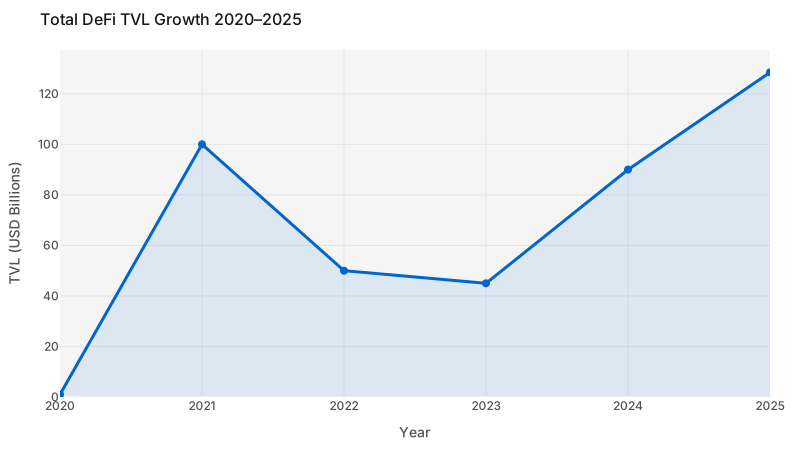
DeFi Total Value Locked grew from under $1B in 2020 to $128B+ by early 2026
Understanding Decentralization
"Decentralized" is not binary. The DeFi ecosystem spans a spectrum from fully centralized products that happen to use a blockchain, to fully decentralized protocols governed by token holders. Understanding where a given product sits on this spectrum is essential for evaluating risk, regulatory exposure, and career opportunities.
The Decentralization Spectrum
Each point on the spectrum involves trade-offs. Coinbase (CeFi) offers customer support, fiat on-ramps, and regulatory compliance — at the cost of custody of your assets and KYC requirements. Uniswap (DeFi) offers permissionless access and self-custody — at the cost of complexity and no recourse if you make an error. MakerDAO (DAO) distributes protocol governance to MKR token holders, enabling community ownership — but also requires active participation to influence outcomes.
For professionals entering Web3, this spectrum shapes job function. CeFi companies hire compliance officers, customer success managers, and traditional finance analysts. DeFi protocol teams hire smart contract engineers, tokenomics designers, and DAO governance specialists. Understanding where on the spectrum you want to work shapes the skills you should prioritize.
DeFi's Transformative Potential
The implications of DeFi extend beyond faster settlement times and lower fees. Three structural shifts are redefining what financial services can be:
Financial inclusion at scale. Globally, 1.7 billion adults lack access to a bank account — not because they lack assets or income, but because they lack the documentation, physical proximity, or government recognition required by traditional banks. DeFi protocols require only an internet connection and a wallet address. This is a genuine paradigm shift for emerging markets.
Programmable money and 24/7 markets. Unlike equities (open 6.5 hours/day, 5 days/week), DeFi markets never close. Smart contracts enable money to be programmed: streaming payments that release per second, escrow that self-executes on delivery confirmation, insurance that pays out automatically on verified event data. These are not enhancements to existing products — they are products that did not previously exist.
Transparency and auditability. Every transaction, every contract, every governance vote in DeFi is recorded on a public blockchain and verifiable by anyone. This transparency — unprecedented in financial services — creates new audit requirements, new compliance tooling opportunities, and new accountability structures for institutions that participate.
Key Takeaways
- DeFi has grown from under $1B to $128B+ TVL in five years, driven by composable smart contracts
- Smart contracts eliminate intermediaries — trades, loans, and swaps execute via code, not institutions
- Composability ("money legos") enables protocols to build on each other, creating compounding innovation
- The decentralization spectrum runs from CeFi (Coinbase) through DeFi (Uniswap) to DAOs (MakerDAO) — each with distinct trade-offs
- 1.7 billion unbanked adults represent DeFi's largest untapped market, enabled by wallet-only access