You don't need to start from scratch. If you can write Python, you can learn Solidity in weeks. If you understand databases, you can grasp on-chain data structures. The technical gap between Web2 and Web3 is narrower than most people think — here's exactly what you need to bridge it.
Programming Languages
The blockchain industry has consolidated around a small set of languages, and the right choice depends entirely on where you want to work. Smart contract roles demand Solidity first and foremost — it remains the lingua franca of EVM-compatible chains, which account for roughly 70% of all DeFi activity. Rust is the second most strategically valuable language, powering the fastest-growing Layer 1 ecosystems and commanding a significant salary premium.
The good news: Python and TypeScript — languages millions of developers already know — translate directly into blockchain tooling roles. Python drives data pipelines, backtesting frameworks, and smart contract scripting tools like Brownie and Ape. TypeScript is the standard for frontend dApp development and is deeply embedded in Hardhat, the most widely-used Ethereum development environment. You likely already have a head start.
Salary impact figures based on 2025 Web3 compensation surveys. Demand ratings reflect job posting frequency across LinkedIn, Crypto Jobs List, and Web3.career.
One reality check worth stating clearly: you don't need to master all four languages before you start applying. Most blockchain roles require one primary language with working familiarity in one or two others. A smart contract security auditor needs deep Solidity and enough Rust to read Solana programs. A DeFi data analyst needs Python expertise and basic Solidity reading comprehension. Pick your target role first, then work backwards to the language priority list.
Development Frameworks and Tools
The blockchain development toolchain has matured rapidly over the past two years. The era of fragmented, inconsistent tooling is largely over — a clear set of industry-standard tools has emerged, and knowing them signals professional credibility in interviews.
Hardhat vs Foundry is the most consequential tooling choice for Ethereum developers. Hardhat remains dominant for JavaScript/TypeScript-first teams due to its plugin ecosystem and familiar testing patterns. Foundry has rapidly gained ground as the professional auditor's choice — its fuzzing capabilities, gas reporting, and pure-Solidity test environment catch vulnerabilities that Hardhat tests routinely miss. In 2025, Foundry is the default for new protocol development; Hardhat remains important for maintaining existing codebases and teams with heavy frontend integration.
ethers.js vs viem: ethers.js v6 dominated Web3 frontend development for years and remains extensively used in production. viem, released in 2023, offers a TypeScript-first API with superior type safety and smaller bundle size. New projects increasingly default to viem; ethers.js knowledge remains essential for working with the majority of existing codebases and documentation.
TheGraph solves one of DeFi's most practical problems: querying historical on-chain data efficiently. Rather than replaying thousands of blockchain events to reconstruct state, TheGraph indexes protocol events into a queryable GraphQL API. Any protocol with a subgraph becomes dramatically easier to analyse — portfolio dashboards, analytics platforms, and alert systems all depend on it. Understanding how to query existing subgraphs and, more valuably, how to write your own is a genuine differentiator.
IPFS and Arweave address decentralised storage — the alternative to centralised cloud storage for NFT metadata, protocol documentation, and front-end hosting. IPFS provides content-addressed storage with a P2P network; Arweave adds permanent storage guarantees through an endowment model. NFT platforms and censorship-resistant applications rely on these. You don't need to run an IPFS node, but understanding content addressing and how pinning services work is practical knowledge for any frontend blockchain developer.
Skill Importance Across Blockchain Roles
Relative importance rating (0-10) by role category
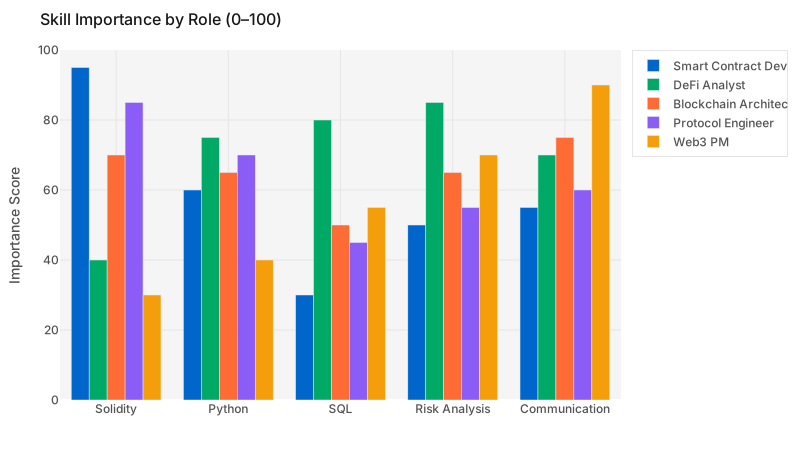
Testing and Security
Testing in smart contract development is not optional — it's the primary defence against vulnerabilities that cannot be patched post-deployment. The industry standard for new protocol development combines unit tests, integration tests, and fuzz testing through Foundry's test suite.
Foundry fuzzing is a technique where the test framework automatically generates thousands of random inputs and searches for inputs that violate your invariants. A simple invariant for a lending protocol might be: “the total borrowed can never exceed total deposited.” Foundry will attempt to break this with edge-case inputs you'd never manually think to test — and often finds critical bugs before auditors do. Fuzz testing is now expected on any protocol seeking a reputable security audit.
Formal verification takes testing further by mathematically proving properties about your code rather than testing a subset of cases. Tools like Certora Prover and Halmos allow developers to write formal specifications and verify them against the smart contract. It's more resource-intensive than fuzzing but provides the strongest guarantees available. Major DeFi protocols with billions in TVL now routinely include formal verification as part of their security process.
Common vulnerability patterns you must understand before auditing or developing:
Reentrancy
Contract A calls Contract B; Contract B calls back into Contract A before the first call completes. Classic example: the DAO hack ($60M). Prevention: checks-effects-interactions pattern or ReentrancyGuard.
Frequency: Very common in auditsFront-Running / MEV
Miners and bots observe pending transactions and insert their own transactions ahead. Price oracles reading mempool-visible DEX prices are especially vulnerable. Mitigations: commit-reveal schemes, private mempools (Flashbots Protect).
Frequency: Common in DeFiInteger Overflow / Underflow
Pre-Solidity 0.8.0, arithmetic could silently overflow/underflow. Solidity 0.8+ reverts by default; unchecked blocks reintroduce the risk. Always verify arithmetic in unchecked blocks during audits.
Frequency: Historical, still found in legacy codeAccess Control Flaws
Missing or incorrect function modifiers allowing unauthorised callers to execute privileged operations. Missing onlyOwner on admin functions, initializer functions callable multiple times. 30%+ of critical audit findings involve access control.
Frequency: Most common critical findingAudit preparation means making your codebase audit-ready before the engagement begins: comprehensive NatSpec documentation on every function, test coverage above 90% for all critical paths, a security-focused README explaining trust assumptions and privilege levels, and a clear scope definition. Auditors who receive well-prepared codebases produce better reports — your preparation directly impacts the audit's effectiveness.
Learning Path Recommendations
The fastest path from zero to blockchain-employable is 90-120 days of focused practice, not passive consumption of tutorials. The following 30-day foundation sprint is the recommended starting point regardless of your background.
30-Day Technical Foundation Sprint
2-3 hours daily commitment
Solidity Basics
- ✓Complete CryptoZombies (free, interactive)
- ✓Write a simple ERC-20 token from scratch
- ✓Deploy to Sepolia testnet using Remix
- ✓Read deployed contract on Etherscan
Tooling and Testing
- ✓Set up Foundry development environment
- ✓Write unit tests for your ERC-20 token
- ✓Run first fuzz test, interpret results
- ✓Fork mainnet and interact with Uniswap in tests
Protocol Interaction
- ✓Build a simple frontend with ethers.js or viem
- ✓Query Uniswap subgraph via TheGraph
- ✓Contribute a small fix to an open-source DeFi repo
- ✓Write a short post-mortem of a past DeFi exploit
Recommended resources: Ethereum.org's developer documentation is the authoritative reference, updated with each protocol upgrade. Cyfrin Updraft (cyfrin.io) provides the most comprehensive free smart contract security course available in 2025-2026. Patrick Collins' YouTube channel bridges theory and hands-on practice better than any paid course. For Rust and Solana, the Solana Cookbook (solanacookbook.com) and Anchor framework documentation are the standard starting points.
Portfolio projects that stand out: a yield aggregator that routes between Aave and Compound based on optimal rates (demonstrates protocol composability), a governance contract with on-chain voting and time locks (demonstrates security awareness), or a Uniswap V3 liquidity management bot (demonstrates MEV awareness and protocol depth). These demonstrate applied knowledge far more effectively than tutorial completions or certifications.
Key Takeaways
- 1Solidity is the highest-demand language — it appears in 80% of blockchain developer job postings
- 2Rust commands a significant salary premium and opens doors to the fastest-growing L1 ecosystems
- 3TypeScript is your daily-driver for frontend dApp development and testing tooling
- 4Foundry has overtaken Truffle as the standard testing framework — start there, not with legacy tools
- 5A portfolio with 2-3 audited, deployed contracts on testnet demonstrates more than any certification