A senior smart contract developer in Web3 earns $180K–$250K base — but that's only part of the picture. Token grants, protocol revenue sharing, and governance rights can double total compensation. Understanding the full package is essential for negotiating effectively.
Base Salary Ranges
Base salaries in blockchain span $65K for junior analysts to $350K+ for principal protocol engineers and ZK specialists. The range is wide because skill scarcity, protocol funding levels, and geographic location create compound variance. A mid-level smart contract developer at a well-funded Ethereum L2 in New York earns materially more than the same skill set at an early-stage protocol headquartered remotely.
US roles carry a 20–35% premium over UK equivalents and 40–60% over APAC rates for the same seniority level. Remote roles are typically benchmarked between US and UK levels, though elite talent can negotiate US rates regardless of location. On-site positions in regulatory hubs (Dubai, Singapore, Zug) add 15–25% further due to cost-of-living and visa-value adjustments.
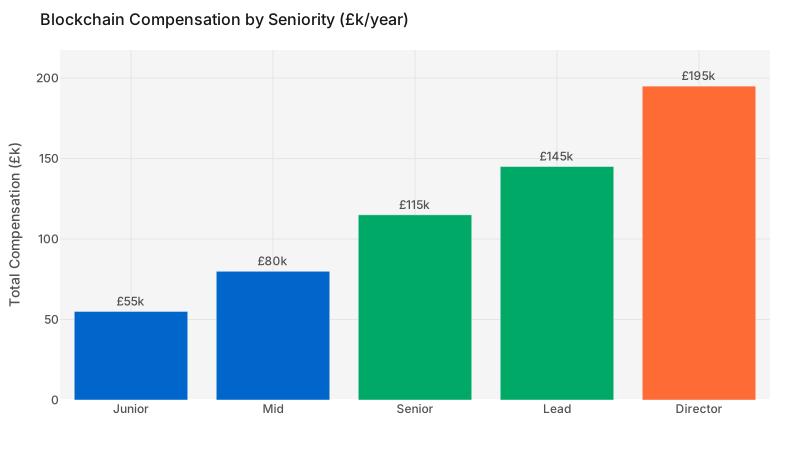
Compensation by Seniority Level
Smart Contract Auditor
Junior (0–2 yrs)
$85K–$120KMid (3–5 yrs)
$140K–$200KSenior (6+ yrs)
$220K–$350K+ZK / Protocol Engineer
Junior (0–2 yrs)
$95K–$130KMid (3–5 yrs)
$160K–$220KSenior (6+ yrs)
$240K–$350K+DeFi Protocol Developer
Junior (0–2 yrs)
$80K–$115KMid (3–5 yrs)
$130K–$180KSenior (6+ yrs)
$200K–$280KBlockchain Data Analyst
Junior (0–2 yrs)
$65K–$90KMid (3–5 yrs)
$100K–$145KSenior (6+ yrs)
$155K–$210KWeb3 Product Manager
Junior (0–2 yrs)
$75K–$105KMid (3–5 yrs)
$120K–$165KSenior (6+ yrs)
$175K–$240KToken Compensation
Token grants function as the Web3 equivalent of equity. A mid-level developer joining a funded protocol might receive a grant worth $80K–$200K at current token price, vesting over four years with a one-year cliff — mirroring how traditional tech companies structure RSUs. The critical difference is token price volatility: that grant might be worth $400K or $20K by the time it vests.
For pre-launch protocols, grants are in unlisted tokens with speculative value — essentially startup equity but with more volatile outcomes. For established protocols (Uniswap, Aave, Compound), grants are in liquid tokens with market-discoverable prices, making them evaluable much like public company RSUs.
Standard Token Vesting Structure (4-Year, 1-Year Cliff)
Monthly vesting after the cliff (months 13–48) at 1/36th of remaining grant per month is the industry standard. Some protocols use quarterly tranches or custom milestones.
Key evaluation criteria for token grants: How much of the total token supply is allocated for team grants? (Red flag: >30%). Is the token already trading? What is the fully diluted valuation? Does vesting continue if you leave, or does unvested token lapse? Can grants be converted to stablecoins at vesting? These questions determine whether a token grant represents real compensation or speculative noise.
Total Compensation Framework
Total compensation in Web3 has four components: base salary, token grants, protocol benefits, and governance rights. Traditional tech professionals typically compare Web2 RSUs to Web3 token grants — but the comparison requires risk adjustment.
Web2 Total Comp
- + Predictable RSU value (public co.)
- + Tax-advantaged ESPP schemes
- + Defined pension / 401(k) match
- − No upside beyond stock price
- − Locked 4-year vest, limited flexibility
Web3 Total Comp
- + Token upside in early-stage protocols
- + Protocol revenue sharing possible
- + Governance token voting rights
- − Token price can go to zero
- − Complex tax treatment of token grants
A practical risk adjustment: discount early-stage token grants by 70–80% when comparing to cash-equivalent Web2 packages. For established protocols with 12+ months of trading history and deep liquidity, a 30–50% discount is more appropriate. This reflects both liquidation risk and token price volatility over the vesting period.
Negotiation Tips
Effective negotiation in Web3 requires specific market knowledge. The primary benchmarking sources used by hiring managers are Levels.fyi (particularly for companies with traditional tech crossover), Web3.career salary data, and Talent Protocol compensation reports. Arriving with specific data points from these sources transforms negotiation from speculation to evidence-based discussion.
Token Compensation Red Flags
Team allocation exceeds 25–30% of total supply
High dilution risk, misaligned incentives
No vesting cliff — tokens accessible immediately
Dump pressure, short-term thinking
Grant denominated in token count (not dollar value)
Deflects attention from current valuation
Token not yet launched, no timeline given
May never materialise; treat as $0
No secondary market or liquidity mechanism
Cannot realise value even after vesting
Career stage matters when deciding between equity-heavy and salary-heavy offers. Early-career professionals should prioritise base salary stability while building track record. Mid-career professionals with demonstrated expertise can take calculated token risk in exchange for upside. Senior professionals at established protocols can negotiate both: high base + governance tokens in liquid protocols with proven revenue.
Key Takeaways
- 1Base salaries range from $65K (junior analyst) to $350K+ (principal ZK engineer) — US commands a 20–35% premium over UK equivalents.
- 2Token grants function as equity: 4-year vesting with 1-year cliff is standard; risk-adjust by 30–80% depending on protocol maturity.
- 3Total compensation = base + tokens + benefits + governance rights — always evaluate the full package, not just the headline number.
- 4Red flags include team allocations above 30%, no vesting cliff, and grants denominated in token count rather than dollar value.
- 5Benchmark using Levels.fyi and Web3.career data; specific market data transforms negotiation from speculation to evidence.