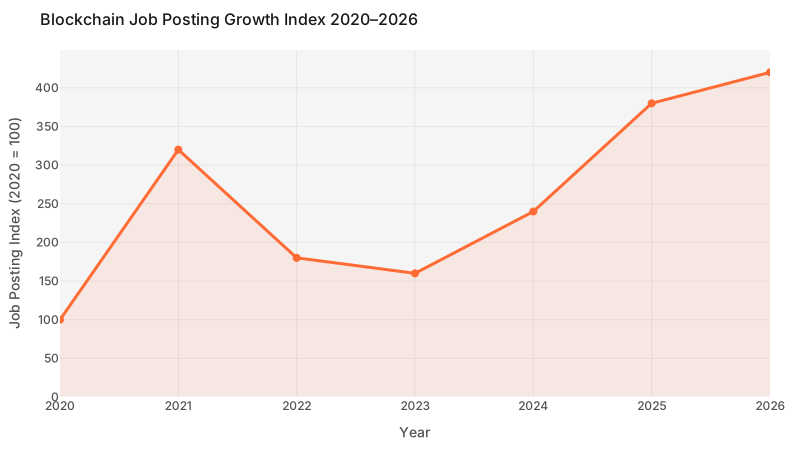
Blockchain hiring grew 45% year-over-year in 2025, outpacing every other technology sector. But the market isn't uniform — demand for smart contract auditors is up 120% while generic 'blockchain developer' listings are flattening. Understanding where the market is heading determines whether you're positioned for opportunity or obsolescence.
Market Overview
The global blockchain technology market is projected to reach $20B+ by 2027, driven by DeFi maturation, institutional adoption, and the explosion of Layer 2 infrastructure. In 2025, the sector posted 45% year-over-year growth in job postings — the fastest of any technology vertical, surpassing AI/ML roles in specialist-level demand.
Active open positions exceeded 12,000 globally by late 2025, with concentration in three regions: the United States (35% of postings, particularly New York and San Francisco), the UK and EU (28%, led by London, Zurich, and Amsterdam), and the Asia-Pacific corridor (25%, centred on Singapore, Hong Kong, and Dubai). The remaining 12% are fully remote-first roles with no geographic constraint.
Geographic hotspots are no longer just financial centres. Dubai's VARA regulatory framework and Singapore's MAS licensing regime have created genuine crypto-industry clusters where companies are headquartered specifically for regulatory clarity, creating co-located hiring demand. For professionals, this means proximity to a regulatory hub can be as valuable as proximity to traditional finance.
Blockchain Hiring Growth 2020–2026
In-Demand Roles
The market has stratified sharply. Demand is not for generalist "blockchain developers" — it is for professionals with deep specialisation in a narrow technical discipline. The five fastest-growing roles by demand growth illustrate this precisely:
Role Demand Growth (YoY, 2025)
Smart contract auditors top the list because protocol teams face existential risk from unaudited code. The $2.5B+ lost to bridge and protocol exploits in 2022–2024 created a structural shift: boards and investors now mandate independent audits, and supply of qualified auditors cannot keep pace with demand.
ZK engineers are the most technically challenging hire — zero-knowledge proof systems require mastery of cryptographic mathematics that fewer than 500 practitioners globally can claim. Demand for this role will outpace supply for at least the next five years, translating to salary premiums of 40–60% over standard protocol developers.
Industry Segments
The blockchain job market is not monolithic. Five distinct segments employ blockchain professionals, each with different growth trajectories, skill requirements, and compensation structures. Understanding segment dynamics helps you target your positioning.
DeFi
Protocols, AMMs, lending platforms
Infrastructure
L2s, bridges, RPC, indexing
Enterprise
Permissioned chains, tokenisation
NFT / Gaming
GameFi, digital collectibles
Regulatory / Compliance
AML, licensing, policy
DeFi dominates at 35% of all blockchain roles and continues to grow as protocols expand governance, risk management, and data teams. Infrastructure is the second growth engine — every new L2 network requires protocol engineers, DevOps, and security specialists, and the L2 ecosystem doubled in chain count during 2025.
NFT and gaming roles have contracted from their 2021–2022 peak but remain a viable segment for product and community specialists. Enterprise blockchain (private/permissioned chains) has stabilised after years of scepticism — tokenisation of real-world assets (RWA) is creating fresh demand specifically for professionals who can bridge legacy finance and on-chain systems.
Geographic and Remote Trends
Over 60% of blockchain job postings explicitly offer remote work — the highest remote ratio of any technology sector. This is a structural feature of the industry rather than a pandemic legacy: Web3 protocols are inherently global, teams span time zones by design, and compensation benchmarking against international talent pools is standard practice.
Salary arbitrage remains real. A London-based senior smart contract developer might earn £140K on-site; the same role offered remote-first may pay $200K USD to attract global candidates. For professionals in lower cost-of-living regions — Eastern Europe, Southeast Asia, Latin America — the arbitrage translates to exceptional purchasing power.
Regulatory hubs (Dubai, Singapore, Switzerland) command on-site premiums of 15–25% above remote equivalents due to visa-friendly regimes and proximity to capital. Emerging markets — particularly Vietnam, Poland, and Brazil — have developed strong protocol engineering talent pools, with local salaries 40–60% below US rates for comparable skills, creating hiring arbitrage for remote-first companies.
Key Takeaways
- 1Blockchain hiring grew 45% YoY in 2025 — the fastest of any technology sector — with 12,000+ open positions globally.
- 2Smart contract auditors (+120%) and ZK engineers (+95%) are the highest-demand specialisations with significant supply gaps.
- 3DeFi employs 35% of all blockchain professionals; infrastructure is the second growth engine following L2 expansion.
- 4Over 60% of positions are remote-first, creating genuine salary arbitrage for professionals in any location.
- 5Geographic hubs (Dubai, Singapore) offer 15–25% on-site premiums driven by regulatory clarity and capital proximity.